
The Two American Heroes Who Saved the Leaning Tower of Pisa and the Camposanto – Tower Parking Pisa
Many tourists visit Pisa’s Piazza dei Miracoli without knowing that its two most important monuments, the Leaning Tower of Pisa and the Camposanto Monumentale (Monumental Cemetery), still stand today thanks to the courage of Sergeant Leon Weckstein and the determination of Captain Deane Keller. It is thanks to them that these two “Miracles” were saved from total destruction during World War II.
The Two Saved “Miracles”: The Leaning Tower and the Camposanto Monumentale
It was the poet Gabriele D’Annunzio who coined the phrase “Prato dei Miracoli” (Meadow of Miracles) which was later popularized worldwide as “Piazza dei Miracoli” (Square of Miracles). He used it to describe the walled, green lawn that holds Pisa’s four architectural wonders: the famous Leaning Tower (which is actually a bell tower, or campanile), the Cathedral, the Baptistery—the largest in the Christian world—and the Camposanto Monumentale.
The locals call it a “Camposanto” (holy field) rather than a regular cemetery because Pisan ships brought sacred soil back from Golgotha to bury their most illustrious citizens. Since then, “campo santo” has become a synonym for cemetery in the Italian language, specifically implying blessed soil from the Holy Land. Of these four extraordinary monuments, at least two came dangerously close to disappearing forever during World War II. That they survived is due entirely to Leon Weckstein and Deane Keller.
Tower Parking Pisa: Your Starting Point to See the Miracles of the Piazza dei Miracoli
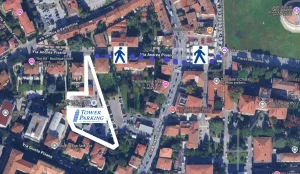
Before we tell you the story of the two American soldiers who saved the Leaning Tower of Pisa and the Camposanto Monumentale from destruction, we want to reassure you: all four architectural wonders of the Piazza dei Miracoli are still here in Pisa, standing in all their breathtaking beauty. They await tourists with their brilliant white marble and the exquisite craftsmanship of their carvings and frescoes—just a 3-minute walk from our facility. Tower Parking is the best choice for parking near the Leaning Tower of Pisa and the Piazza dei Miracoli: a secure, monitored facility equipped with private individual garages, located just steps away from the square!
Leon Weckstein: The Soldier Who Chose Not to Shoot at the Tower
The Dilemma of a Young Sergeant in a Besieged Pisa
In July 1944, Pisa was split in two. North of the Arno River, Nazi troops occupied the city following the fall of Mussolini. South of the Arno, near the coast, American and Allied forces had captured Livorno and Marina di Pisa. They were preparing to cross the river to liberate the rest of the city and continue their push northward.
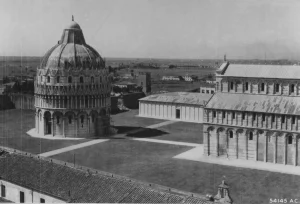
The fighting was intense. German forces used church bell towers as sniper outposts and artillery observation points to fire on American positions. Allied officers became convinced that an observation post was hidden inside the Leaning Tower itself. Its massive white marble structure offered an unobstructed view toward the southwest and the mouth of the Arno River.
The grueling task of advancing, scouting the tower, and potentially ordering Allied ships stationed at the mouth of the Arno to fire upon it was assigned to a young radio operator, Sergeant Leon Weckstein. While military rules of engagement generally protected churches and historical sites, too many American soldiers were dying. If deemed a military necessity, the Leaning Tower of Pisa would be reduced to a pile of rubble.
To Order Fire or Not? An Act of Foresight That Saved a World Heritage Site
The day was clear. For hours, the sergeant scanned the tower through his binoculars, looking for any sign of enemy movement. He deeply felt the weight of destroying such a magnificent monument, yet he knew his primary duty was to protect the lives of his fellow soldiers. He stared at the marble structure for eight consecutive hours until the intense heat of the high sun caused the air to shimmer, making the tower appear to vibrate.
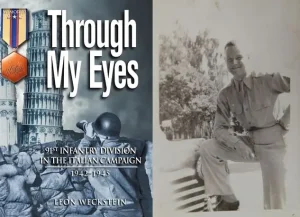
Weckstein hesitated. He wanted to be absolutely certain before giving an order that would destroy history, ensuring his nearsighted eyes were not misinterpreting the heat shimmer as enemy movement. He held his fire. Finally, a fallback order arrived: the General had decided to bypass Pisa, making the immediate destruction of that sector unnecessary. The Leaning Tower of Pisa was saved by the hesitation of a young sergeant who refused to rush into destroying a monument of white marble shimmering in the heat.
Where to Find More Information on Leon Weckstein
Leon Weckstein detailed his experience saving the tower in his personal wartime memoir:
- Through My Eyes: 91st Infantry Division in the Italian Campaign, 1942-45
You can also watch a historical interview with him here: memorysharing.it
Deane Keller: The “Monuments Man” Who Revived the Camposanto
That Fateful Day: July 27, 1944
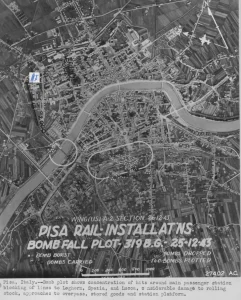
By July 27, 1944, heavy Allied bombings—which began on August 31, 1943, and intensified through January, May, June, and July of 1944—had left much of Pisa in ruins. Miraculously, the Piazza del Duomo remained largely untouched, as both armies had baseline respect for the sacred nature of the square.
Though the Tower was safe due to Weckstein’s hesitation (a fact discovered much later), violent artillery duels still took place nearby, given the square’s proximity to the northern railway line. During an exchange of fire, a stray piece of artillery shrapnel struck the roof of the Camposanto Monumentale. This structure housed the most important cycle of fourteenth-century frescoes in the medieval world—a monument that had been a focal point for artists and intellectuals during the historic Grand Tour era.
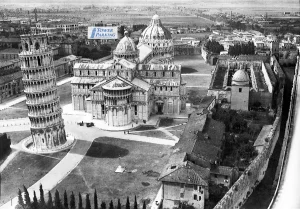
A Single Artillery Fragment: Fire Destroys the Roof
The shrapnel impact ignited a fire on the wooden roof. With the city’s infrastructure completely shattered, fighting the blaze proved impossible. The intense heat melted the building’s lead roofing material, causing molten lead to pour down the walls, severely damaging and burning the ancient frescoes underneath. Technicians from the Opera della Primaziale (the cathedral authority) were among the first to reach the scene, recording the catastrophe:
“At approximately 7:30 PM, following Anglo-American artillery shelling, the roof of our beautiful Camposanto caught fire. Attempts to contain the blaze were futile due to inadequate equipment and ongoing shelling. By midnight, the famous Camposanto was half-destroyed, and the roof was entirely consumed.” — Bruno Farnesi, Assistant at the Opera della Primaziale, July 27, 1944
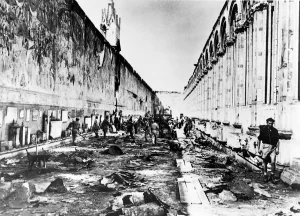
The Race Against Time to Save Lost Art
Over 1,500 square meters (more than 16,000 square feet) of medieval frescoes appeared lost forever. The Camposanto Monumentale—an architectural masterpiece designed by Giovanni di Simone in 1270 and painted during the 1300s and 1400s—had sustained what looked like a fatal blow.
Beyond its frescoes, the building housed a world-renowned collection of ancient Roman sarcophagi, gathered over centuries by Pisan ships across the Mediterranean. The damage shocked the global scientific and academic community.
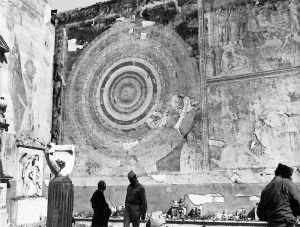
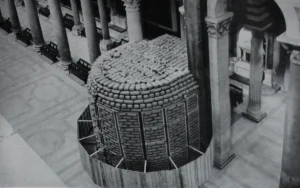
Cathedral technicians immediately launched emergency salvage operations. Fragmented remains of the frescoes lay on the floor, fused with cooled lead, while Roman marbles were cracked and scorched by the heat. However, the city lacked basic materials, making even a temporary protective roof impossible to construct.
Deane Keller: A Lifetime Commitment to Preservation
On September 2, 1944, immediately after the city’s liberation, Captain Deane Keller—an officer and art historian with the Allied Monuments, Fine Arts, and Archives (MFAA) section, known as the “Monuments Men”—entered Pisa. With winter approaching, the rainy season threatened to permanently wash away what remained of the exposed frescoes. Timber was desperately needed for a temporary roof. Recognizing the urgency, Captain Keller took decisive action. He formally requisitioned a shipment of military timber at the nearby port of Livorno that had been earmarked for combat engineering operations. This intervention allowed teams to build a temporary protective cover over the structure.
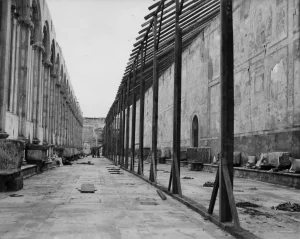
This roof made all subsequent preservation operations possible: securing and detaching the surviving frescoes, discovering the original underlying preparatory drawings (the sinopie, which led to the creation of Pisa’s Museo delle Sinopie in the 1960s), and beginning the slow reconstruction of shattered marbles. From that day forward, Keller worked alongside local Italian technicians and the monuments superintendency to stabilize the site while the war still raged in northern Italy.
Deane Keller: The American Guardian of the Camposanto
After returning to the United States, Keller spent decades raising funds to continue the restoration work—a massive project that lasted for generations. He passed away in 1992. In accordance with his final wishes, his remains were buried inside the Camposanto he helped save. He remains the only American and the only soldier granted this honor, an official recognition of an act of preservation without which these frescoes, sculptures, and architectural elements could not be viewed by modern visitors today.
DEANE KELLER
PITTORE
14 XII 1901 12 IV 1992
UFFICIALE DELLA V ARMATA STATUNITENSE
NEL SETTEMBRE – OTTOBRE 1944
INCOMBENTE ANCORA LA MINACCIA NEMICA
PROCURO’ MATERIALI E MEZZI
PERCHE’ QUESTO CAMPOSANTO
QUASI DISTRUTTO DALLA GUERRA
FOSSE PRESERVATO DALL’ESTREMA ROVINA
AMICISSIMUS AD AMICOS
MAGGIO 2000
approximate English translation:
DEANE KELLER
PAINTER
14 XII 1901 12 IV 1992
US FIFTH ARMY OFFICER
IN SEPTEMBER – OCTOBER 1944
WITH THE ENEMY THREAT STILL LOOMING
HE PROCURED MATERIALS AND EQUIPMENT
TO ENSURE THIS CAMPOSANTO
ALMOST DESTROYED BY THE WAR
WAS PRESERVED FROM ULTIMATE DESTRUCTION
FRIENDLY TO FRIENDS
May 2000
Where to Find More Information on Deane Keller
An extensive biography of Deane Keller was published by his son:
- Keller, P. M., “A Painter’s Odyssey: The Life of Deane Keller”, 2007.
His salvage operations in Pisa are also detailed in the historical account by Robert M. Edsel:
- Edsel, R. M., “The Monuments Men: Allied Heroes, Nazi Thieves, and the Greatest Treasure Hunt in History”, 2009 (which inspired the feature film of the same name).
Online resources regarding Deane Keller:
- Artonauti – Deane Keller Camposanto di Pisa
- Pisa la città il mare il contado – 27 luglio 1944
- Il Tirreno – lo storico dell’arte in uniforme che fece rinascere il Camposanto
- Secondacronaca – 1944 Missione Camposanto
Plan Your Visit: Walking Directions to the Tower from Tower Parking Pisa
If you are planning a visit to Pisa to admire the Leaning Tower and the Camposanto Monumentale saved by these wartime heroes, and you want to park near the leaning tower of Pisa, choose the convenience of Tower Parking. We provide secure parking solutions so you can enjoy your day with total peace of mind.
The Piazza dei Miracoli is located just a few steps away and can be reached via a short, easy walk.
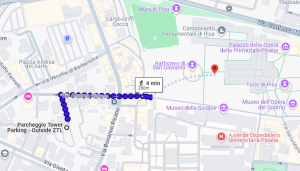
View the walking route on Google Maps: Click here to open the map and get walking directions